Infant crying, fussing, and colic: A thinking parent's guide
© 2009 – 2022 Gwen Dewar, Ph.D., all rights reserved
 opens IMAGE file
Are you coping with baby crying, fussing, or opens in a new windowcolic?
Babies everywhere weep, especially during the first iii months subsequently birth. Even chimpanzees follow this design (Bard 2004). Like information technology or not, crying is a universal way of advice for our species.
But that doesn't hateful we're helpless to meliorate the situation. Parents can have an of import upshot on the amount of time babies cry. Inquiry confirms these points.
ane. Sometimes it's very straightforward–babies experience bad and need assistance.
Babies may cry because they are hungry, distressed, or feeling hurting. Prompt, loving care can make them experience better and terminate crying. Failure to respond can arrive worse.
2. Babies tend to cry when they are out-of-contact with their primary caregivers.
Again, this is pretty simple stuff. Take a immature babe from his mother, and he will start to weep. Infants with secure emotional attachments will normally finish crying after they've been reunited with their caregivers (Bong and Ainsworth 1972; Christensson et al 1995).
iii. Carrying a babe can placidity him or her down…merely you take to keep moving.
It's a common response in many mammals: Infants experience slower heart rates, reduced trunk motility, and reduced crying when they are carried effectually by their parents (Esposito et al 2013). It doesn't last, however. Put the baby downwards, and she may start crying once again.
4. Loving touch helps…every bit long every bit you think like a baby.
Information technology's a common response in many mammals: Infants experience slower heart rates, reduced body movement, and reduced crying when they are carried around by their parents (Esposito et al 2013). It doesn't last, notwithstanding. Put the infant downward, and she may start crying again.

Babies are soothed by rocking and skin-to-peel contact (Byrne and Horowitz 1981; Spencer et al 1990; Gray et al 2000), but information technology's important to call up similar a baby.
Research suggests that young infants don't similar light caresses. They prefer a firmer touch (Kida and Shinohara 2013). Moreover, some babies may feel overly stimulated and need "down fourth dimension," which they will signal by putting their hands over their faces, or trying to look abroad (Beebe 2010).
Finally, babies can get stressed if we touch them in ways that seem emotionally distant — without talking, rocking, or making center contact (White-Traut et al 2009).
v. Harvey Karp's "happiest baby" techniques are constructive.
A practicing pediatrician, Karp recommends that parents respond to a crying infant by taking these steps:
- Swaddle the infant (taking intendance to follow safe swaddling tips, which I discuss in opens in a new windowthis article virtually helping infants sleep)
- Agree the infant so that the infant's side or stomach is contacting your body
- Sooth the baby past making a "shushing" sound
- While supporting your baby'due south head and neck, gently "jiggle" the baby using fast, tiny motions
- Provide your baby with something to suck on (i.due east., a pacifier or breast).
Researchers have tested these techniques, and confirmed that they really do have a calming effect on nearly babies (Möller et al 2019). You lot can read Karp's own business relationship of the method opens in a new windowhere.
6. Infant-directed singing helps babies relax.
New experiments indicate that the old folk beliefs are true: Singing lullabies and nursery rhymes can have a remarkable consequence. When babies were left to sit down in a rather dour, dimly-lit environment, the sound of their mothers' singing kept them at-home for an average of 9 minutes. Babies were also soothed by the sound of opens in a new windowinfant-directed voice communication, just to a lesser degree (Corbeil et al 2015).

7. Reverse to folk beliefs about the dangers of "spoiling" an infant, young babies seem to weep less when they are indulged.
In societies that promote a more indulgent approach to babe care (firsthand responses to crying, very frequent nursing, lots of concrete contact, and cosleeping), babies spend less time crying than they practise elsewhere (eastward.g., Barr et al 1991).
We see the same result amidst chimpanzees, too. When chimpanzee infants are cradled by their mothers 100% of the time, they cry less than when they are held by the moms only 25% of the time (Bard 2004).
8. Bad moods are contagious, even for the very immature.
Every bit I explain in another Parenting Science article, babies notice when nosotros're feeling stressed. They can "catch" our bad moods!
This doesn't hateful that parental emotions are the primary crusade of excessive baby crying or irritability. But information technology's another skillful reason to take your ain psychological symptoms seriously.
Are y'all wondering if you suffer from postpartum depression? See this Parenting Scientific discipline guide for more data.
And if you are feeling broken-hearted or distressed (mutual experiences for new parents) talk over your struggles with a medical provider or counselor.
9. Infant behavior is influenced by developed substance utilize.
Some studies take reported that excessive crying is more likely among babies who were exposed to cigarette fume during pregnancy or after birth (Reijneveld et al 2005; Shenassa et al 2004).
Smoke exposure may increase levels of motilin, a hormone that induces potentially painful abdominal contractions (Shenassa et al 2004). Smoke exposure is as well linked with poorer baby sleep, which could contribute to irritability (Mennella et al 2007).
Other studies propose that booze exposure–during gestation and via breast milk—alters brain development, putting babies at higher risk for irritability, anxiety, and low (eastward.g., Zink et al 2009; Kraemer et al 2008).
10. Information technology's a good thought to screen irritable babies for disease.
Sometimes crying — unusual, prolonged, or inconsolable crying — indicates a medical trouble. As I explain elsewhere, eddressing the underlying opens in a new windowmedical weather condition can help babies calm down.
And so baby crying depends, in office, on the deportment and choices of adults. But beware of the blame-game. Sometimes, a baby keeps on crying — despite our all-time efforts!
Not all infants are akin. Some babies are especially challenging or emotionally reactive — even when parents do their utmost to be responsive and caring.
Then is excessive baby crying or fussing a sign that parents aren't nurturing their babies enough?
It'south a loaded question, one that implicitly blames parents for their babies' credible misery.
On the positive side, it'south reasonable to think that physical nurturing—sensitive, responsive intendance that includes lots of concrete contact—is good for everyone.
opens in a new windowBabies are born with biases for social stimuli. In general, babies are soothed by feeding (Shaw et al 2007), skin-to-skin contact (Gray et al 2000), and gentle touches that are combined with other forms of advice, similar talk or heart contact (White-Traut et al 2009).
Moreover, we know that babies evolved in the context of being fed very frequently and carried around by parents, aunts, grandmothers, or siblings virtually of the day (Konner 2005).
Among modern-solar day hunter-gatherers–people who still practise this "Pleistocene" approach to baby care–lengthy, inconsolable bouts of infant crying are rare (Fouts et al 2004).
There is besides experimental evidence suggesting that normal Western infants cry less when their parents make a special endeavor to behave their babies more often.
In a randomized experiment, some mothers were assigned to carry their infants more, and their infants cried less relative to a command grouping (Hunziker and Barr 1986).
But–as many drastic parents know–even babies who are held and fed often may endure from excessive, inconsolable crying.
Carrying babies has many benefits, simply it isn't a cure-all.

As noted to a higher place, keeping babies shut may reduce infant distress. And holding babies may be benign in other ways, likewise.
For instance, one experimental report found that mothers who wore their infants in soft baby carriers were more likely to take securely-attached babies than were moms who carried their babies in portable baby seats (Anisfeld et al 1990).
Clinical and anecdotal experience too suggests that infant-carrying tin can be an constructive arroyo for babies who are "fussy" or "loftier need" (Sears and Sears 1996).
Just nosotros shouldn't presume that infant carrying is the respond to all problems.
Experimental studies suggest that increased carrying doesn't reduce crying in babies who've been diagnosed with colic — frequent, prolonged bouts of inconsolable crying (Barr 1991; St James-Roberts et al 1995).
And research has failed to demonstrate that parenting differences within Western populations are linked with colic. For example, in one written report, Ian St. James-Roberts and his colleagues tracked three groups of new parents—
- Parents living in London
- Parents living in Copenhagen
- A special group of parents who said they planned to practice "proximal care," property their infants at to the lowest degree 80% of the fourth dimension between 8am and 8pm, breastfeeding relatively oftentimes, and responding rapidly to babe cries. Many (but not all) of these parents also expert cosleeping.
Parents in all three groups kept beliefs diaries and filled out questionnaires.
The results? London parents had the to the lowest degree amount of concrete contact with their babies—50% less compared with the parents practicing "proximal care." These parents also had the babies who cried the most.
Just when it came to colicky babies—babies who cried excessively and inconsolably—there was no significant difference betwixt groups (St James-Roberts et al 2006).
So why is excessive, comfortless crying rare amongst hunter-gatherers?
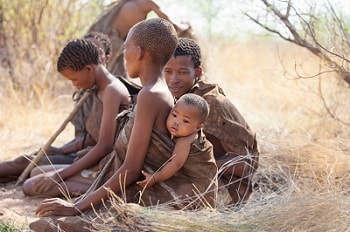
I don't know, and I don't recall anyone else does, either. Simply if you compare hunter-gatherers with the balance of u.s., at that place is more going on than a unlike arroyo to babe-carrying.
Possibly, the absence of colic in foraging societies reflects differences in diet, sleep, feeding, parental support, or even genes.
Gut flora and diet
The emerging consensus among researchers is that colicky babies are more likely to accept an imbalance of leaner in their digestive tracts: Lower concentrations of the "proficient" or probiotic species, and higher concentrations of bacteria that can cause gas and inflammation (Pärtty and Kalliomäki 2017).
Hunter-gatherer diets are radically dissimilar from near agricultural, industrial diets, and dietary differences could contribute to differences in gut flora. For example, hunter-gatherers don't drink cow'south milk, and moo-cow's milk protein intolerance can cause excessive, inconsolable crying. And so it's plausible that diet explains lower rates of colic among foraging populations.
Slumber
Some researchers speculate the colic is acquired by an young slumber/wake system. Perhaps colicky babies don't produce enough melatonin in the late afternoon and evening. Equally a issue, they become "hyper-alert" and suffer sleep bug (Jenni 2004). They might experience more intestinal pain, too, because melatonin as well suppresses abdominal contractions (Weissbluth and Weissbluth 1992).
If either of these hypotheses are right, and then maybe hunter-gatherers avert colic because they do a better job attuning their babies to daily life. Past exposing babies to natural daylight, and fugitive artificial lighting at dark, parents can opens in a new windowaid a new infant develop mature patterns of melatonin production.
Feeding
Hunter-gatherer babies go fed on need and very ofttimes, sometimes as frequently as four times an hr (Konner 2005). The meals are pocket-size, withal, and this might protect babies from gastroesophageal reflux (also known as heartburn or acid reflux).
Parental support
Much of the research on colic has been done on Western populations where parents—ordinarily mothers—spend long hours in social isolation with their babies. This might contribute to opens in a new windowmaternal anxiety and depression, which, in turn, could aggravate the symptoms of colic.
Among hunter-gatherers, parents are well-nigh never solitary with their babies. Not merely do they get more adult contact, they get more babysitting aid. And hunter-gatherer adults are notably tolerant effectually other people's babies (Fouts et al 2004).
Genes
If colic has a genetic basis–such that sure genes increase a baby's chances of being irritable or difficult to soothe–and then we shouldn't rule out the possibility that hunter-gatherer babies are less probable to possess these genes.
Claims about the absenteeism of colic among hunter-gatherers oft business organization groups like the San or Baka, peoples who testify prove of long-term genetic isolation from surrounding agricultural populations (Verdu et al 2009; Tishkoff 2004).
More information most baby crying
Yous tin read more almost keeping babies at-home in this opens in a new windowParenting science guide to stress in babies.
Merely if you lot have a young baby who cries inconsolably, exist certain to consult your pediatrician and get your infant screened for affliction. Check out my overview of opens in a new windowexcessive, inconsolable infant crying equally well as this article about the opens in a new windowmedical weather condition that can cause excessive crying in babies.
In addition, y'all might be interested in the scientific bear witness that opens in a new windowsome babies are just different –responding more irritably to stimulation that doesn't bother other babies.
And if yous're curious about effects of infant carrying, follow opens in a new windowthis link to a video presentation by researchers who've studied the phenomenon in human and rodent infants (Esposito et al 2013).
References: Infant crying
Anisfeld E, Casper V, Nozyce M, and Cunningham North. 1990. Does infant carrying promote attachment? An experimental study of the effects of increased physical contact on the development of attachment. Kid Dev. 61(v):1617-27.
Barr RG, Konner M, Bakeman R and Adamson L. 1991. Crying in !Kung San infants: A test of the cultural specificity hypothesis. Developmental Medicine and Kid Neurology 33: 601-610.
Bong SM and Ainsworth MDS. 1972. Baby crying and maternal responsiveness. Child Development 43: 1171-1190.
Byrne J and Horowitz F. 1981. Rocking equally a Soothing Intervention: The Influence of Direction and Blazon of Move. Infant Behavior and Development 4: 207-218.
Christensson Chiliad, Cabrera T, Christensson E, Uvnas-Moberg K and Winberg J. 1995. Separation distress call in the human neonate in the absence of maternal trunk contact. Acta Paediatrica 84: 468-473.
Corbeil M, Trehub SE, and Peretz I. 2015. Singing Delays the Onset of Infant Distress. Infancy. Epub ahead of print. DOI: 10.1111/infa.12114
Esposito G, Yoshiaa South, Ohnishi R, Tsuneoka Y, del Carmen Rostagno M, et al. 2013. Baby Calming Responses during Maternal Conveying in Humans and Mice. Current Biology epub alee of print ten.1016/j.cub.2013.03.041.
Fouts HN, Lamb ME, and Hewlett BS. 2004. Infant crying in hunter-gatherer cultures. Behavioral and Brain Sciences 27(4): 462-463.
Greyness 50, Watt L, Blass EM. 2000. Skin-to-skin contact is analgesic in good for you newborns. Pediatrics 105(1).
Hunziker UA and Barr RG. 1986. Increased carrying reduces infant crying: a randomized controlled trial. Pediatrics. 77(5):641-eight.
Kraemer GW, Moore CF, Newman TK, Barr CS, and Schneider ML. 2008. Moderate level fetal booze exposure and serotonin transporter gene promoter polymorphism bear upon neonatal temperament and limbic-hypothalamic-pituitary-adrenal centrality regulation in monkeys. Biol Psychiatry. ;63(three):317-24.
Jenni OG. 2004. Slumber-wake processes play a central role in early on infant crying. Behavioral and Brain Sciences 27(iv): 464-465.
Konner M. 2005. Hunter-gatherer infancy and babyhood: The !Kung and others. In: Hunter-gatherer childhoods: Evolutionary, developmental and cultural perpectives. BS Hewlett and ME Lamb (eds). New Brunswick: Transaction Publishers.
Mennella J. 2007. Breastfeeding and smoking: Short-term effects on baby feeding and slumber. Pediatrics 120 (3):497-502.
Möller EL, de Vente W, Rodenburg R. 2019. Infant crying and the calming response: Parental versus mechanical soothing using swaddling, sound, and motion. PLoS Ane. 14(four):e0214548.
Pärtty A and Kalliomäki M. 2017. opens in a new windowInfant colic is still a mysterious disorder of the microbiota-gut-brain centrality. Acta Paediatr. 106(4):528-529.
Reijneveld SA, Lanting CI, Crone MR, and Van Wouwe JP. 2005. Exposure to tobacco fume and infant crying. Acta Paediatr. 94(2):217-21. St James-Roberts I, Alvarez M, Csipke E, Abramsky T, Goodwin J, and Sorgenfrei E. 2006. Infant crying and sleeping in London, Copenhagen and when parents prefer a "proximal" class of care. Pediatrics. 117(vi):e1146-55.
St James-Roberts I, Hurry J, Bowyer J, and Barr RG. 1995. Supplementary carrying compared with advice to increment responsive parenting as interventions to forbid persistent babe crying. Pediatrics. 95(3):381-8.
Shah PS, Aliwalas L, and Shah V. 2007. Breastfeeding or chest milk to alleviate procedural pain in neonates: a systematic review. Breastfeeding medicine two:74-82.
Shenassa Eastward and Brownish M-J. 2004. Maternal smoking and infantile gastrointestinal dysregulation: The case of colic. Pediatrics 114(4): 497-505.
Spencer JA, Moran DJ, Lee A, and Talbert D. 1990. White racket and sleep induction.Arch Dis Kid. 65(1):135-7.
Tishkoff SA and Verrelli BC. 2003. Patterns of homo genetic diversity: Implications for Human being Evolutionary History and Disease. Almanac Review of Genomics and Human Genetics iv: 293-340.
van Sleuwen BE, L'hoir MP, Engelberts AC, Busschers WB, Westers P, Blom MA, Schulpen TW, and Kuis Westward. 2007 Comparison of behavior modification with and without swaddling equally interventions for excessive crying. J Pediatr. 149(4):512-7.
Verdu P, Austerlitz F, Estoup A, et al. 2009. Origins and Genetic Diversity of Pygmy Hunter-Gatherers from Western Central Africa Current Biological science, xix (iv), 312-318
Weissbluth L and Weissbluth M. 1992. Infant colic: the outcome of serotonin and melatonin circadian rhythms on the intestinal shine muscle. Med Hypotheses. 39(2):164-7.
White-Traut RC, Schwertz D, McFarlin B, and Kogan J. 2009. Salivary cortisol and behavioral land responses of healthy newborn infants to tactile-but and multisensory interventions. J Obstet Gynecol Neonatal Nurs. 38(1):22-34.
Yazdani One thousand, Ide Thousand, Asadifar M, Gottschalk Southward, Joseph F Jr, and Nakamoto T. 2004. Effects of caffeine on the saturated and monounsaturated Fatty acids of the newborn rat cerebellum. Ann Nutr Metab. 48(two):79-83.
Zink 1000, Araç G, Frank ST, Gass P, Gebicke-Härter PJ, and Spanagel R. 2009. Perinatal exposure to alcohol reduces the expression of complexins I and II. Neurotoxicol Teratol. 31(6):400-v.
title image of begetter with crying infant by Aurimas Mikalauskas / flickr
paradigm of Babywearing mother by opens in a new windowTala Sabine/flickr
prototype of male parent and child by opens in a new windowAndrés Nieto Porras/wikimedia eatables
image of San hunter-gatherer family by romitasromala / istock
Content of "Baby crying in anthropological perspective" terminal modified iii/2020
Source: https://parentingscience.com/infant-crying/
0 Response to "Infant crying, fussing, and colic: A thinking parent's guide"
Postar um comentário