What Language Arts Term Means to Seize the Day
What it actually means to 'seize the day'
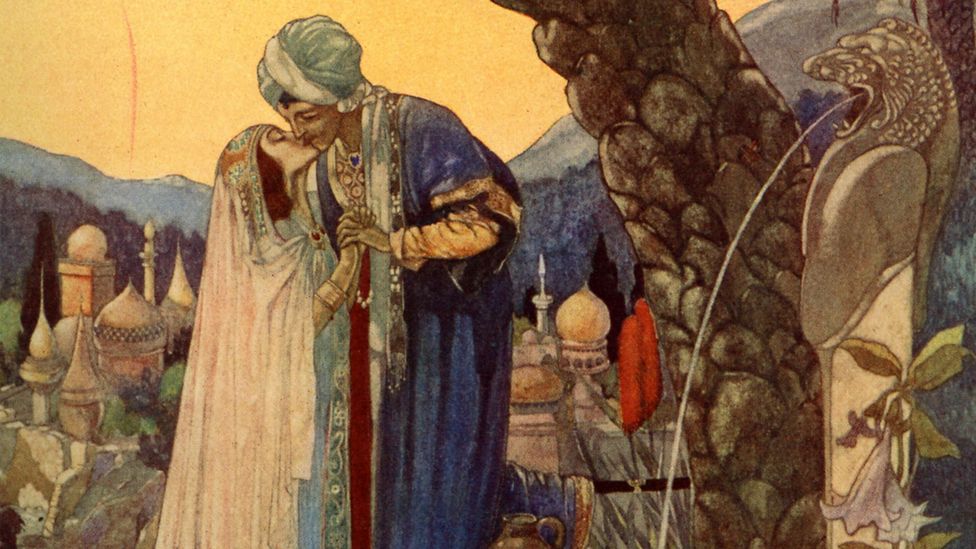
'Seize the day', nosotros are told – but how exactly do we do this? Fiona Macdonald talks to the writer of a new book about how carpe diem tin be reclaimed.
L
Leaning on the rail of a yacht in 1968, looking at the "rocky cliffs, rolling seas, dazzling heaven" of the Dalmatian Straits, the writer and adman Jerry Mander had an epiphany. Or, mayhap, the opposite of one. "It struck me that there was a film between me and all of that," he wrote in his 1977 book Four Arguments for the Elimination of Television. "I could 'see' the spectacular views. I knew they were spectacular. Simply the experience stopped at my optics. I couldn't permit it inside me. I felt zilch. Something had gone wrong with me."
Mander recalled "childhood moments when the mere sight of the sky or grass would send waves of physical pleasure through me" – on the deck, though, "I felt dead," he wrote. "Nature had get irrelevant to me, absent-minded from my life. Through mere lack of exposure and practice, I'd lost the power to experience it, tune into it, or care about it. Life moved too fast for that now."
That was nearly l years ago. The pace of life has been accelerating since – and what Mander described is increasingly widespread, according to the social philosopher Roman Krznaric. "Human beings take always had mediated experiences, ever since the invention of reading – but now things like TV accept so removed us from direct experience of life that nosotros've almost forgotten what it's similar," he tells BBC Civilization. He has a solution. "Information technology's vital to try and recover this carpe diem instinct which is in all of us."
Films similar Dead Poets Lodge (pictured) "requite u.s. a way of thinking about death which doesn't feel too against," says Krznaric. "There'due south a kind of filter" (Credit: Alamy)
Get-go coined by the Roman poet Horace more than 2,000 years agone, carpe diem – or 'seize the day' – is "1 of the oldest philosophical mottos in Western history", says Krznaric, who has written a book chosen Carpe Diem Regained: The Vanishing Fine art of Seizing the Day. Yet information technology's a slippery idea to pin downward. During his inquiry, he found a range of definitions for a concept with dandy resonance in pop culture, one that has inspired songs by Metallica and Green Day and films such as Dead Poets Club. "In that location are dissimilar ways to thinking about it, from seizing opportunities, to spontaneity, to hedonism, to being in the present moment; as well as a collective political class of carpe diem," he says. "They're all different ways of having bureau in the confront of death, of feeling that you're fully alive."
Despite – or perchance because of – its prevalence in culture, carpe diem has been sabotaged by the language of the advertising slogan and the hashtag: 'Only do it' or 'Yolo' (you lot simply live once). Krznaric argues that this has helped strip the concept of its truthful meaning. "The hijack of carpe diem is the existential law-breaking of the century – and ane that nosotros accept barely noticed," he writes.
"Consumer civilisation has captured seizing the day," he tells BBC Culture. "That idea that instead of just doing it, we but buy information technology instead: shopping is the second most popular leisure activity in the Western world, beaten only by tv set. Instead of seizing the day, we're really seizing the credit card."
Carpe diem has too been hijacked by our culture of hyper-scheduled living, argues Krznaric. "'Just exercise it' becomes 'just plan it' – people are filling up their electronic calendars weeks in accelerate with no free weekends. In terms of cultural history, most people are unaware that their spontaneity has been stolen from them over the past half a millennium."
The manufacturing plant clock changed our view of time, says Krznaric: "although nosotros think we lost spontaneity due to things like digital overload, at that place are deeper factors" (Credit: Alamy)
People had more spontaneous lives in the Middle Ages – "partly of class because expiry was so much closer," he says. But the idea that wasting fourth dimension is a sin has become deeply ingrained, "due to the Reformation, which descended similar a frost on Europe – where the church started banning funfair and summer fairs, and there were new laws banning public dancing and games. Then came the Industrial Revolution with its bang-up weapon, the factory clock," says Krznaric.
"We've still got the language that developed as part of the Industrial Revolution, where we've got to be productive with our days and get on with our to-do lists," he says. "We've got quite a struggle ahead of us to reclaim that aspect of carpe diem."
Eastern promise
One way to do this, Krznaric suggests, is to "appreciate that hedonism has long been central to human culture, personal expression and passionate living, and it is essential that we find a place for it in mod life." But the pursuit of pleasance can be viewed with suspicion, he says, "due to the legacy of Greco-Roman moral ethics and pilus-shirt Christian teachings that have slowly infiltrated our minds. For two,000 years there has been a long war against pleasure."
During one of the most seemingly pleasure-bashing periods in history, an alternative set of ideas advocating hedonism captured the popular imagination. A craze for 'the E' that emerged in Victorian Britain was a straight reflection of the moral codes of the twenty-four hour period, argues Krznaric. "This was far more than the fad for Persian carpets and Japanese lacquer article of furniture," he writes. "The Orient also evoked fantasies of erotic sensuality and passionate carpe diem living that were the opposite of sober Victorian Christianity."
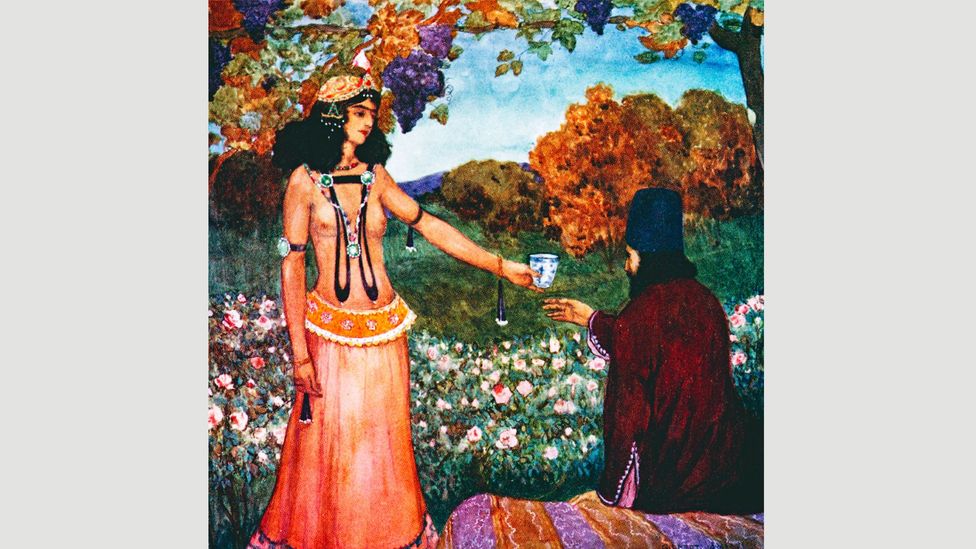
With lines like 'While y'all live/Potable! – for, one time dead, you never shall return', the Rubáiyát of Omár Khayyám celebrated hedonism (Credit: Alamy)
One of the central texts of that moment was Edward FitzGerald'southward loose translation of verses past the 11th-Century Persian poet and mathematician Omár Khayyám – which took the grade of a long verse form chosen the Rubáiyát of Omár Khayyám. Later a copy of the Rubáiyát was passed to the artist Dante Gabriel Rossetti, who shared it with his Pre-Raphaelite circle, John Ruskin alleged, "I never did – till this day – read annihilation and then glorious". Co-ordinate to Krznaric, "From there began a cult of Omár Khayyám that lasted at least until World War One." The poem "was memorised, quoted and worshipped past a whole generation. Omár Khayyám dining clubs sprang up, and you lot could even purchase Omar molar pulverisation and playing cards."
The poem historic hedonism and was, co-ordinate to Krznaric, an "outcry against the unofficial Victorian ideologies of moderation, primness and self-control", in their place offer "sensuous embraces in jasmine-filled gardens on balmy Arabian nights, accompanied by cups of cool, intoxicating vino". The Rubáiyát even appeared to be rejecting organized religion itself, suggesting there was no afterlife, its message one that "since homo beingness is transient and death will come much faster than we imagine, it'due south best to enjoy its exquisite moments". The author GK Chesterton claimed that the Rubáiyát was the Bible of the 'carpe diem religion', while Oscar Wilde described it as a "masterpiece of art", placing it alongside Shakespeare'due south sonnets every bit i of his greatest literary loves.
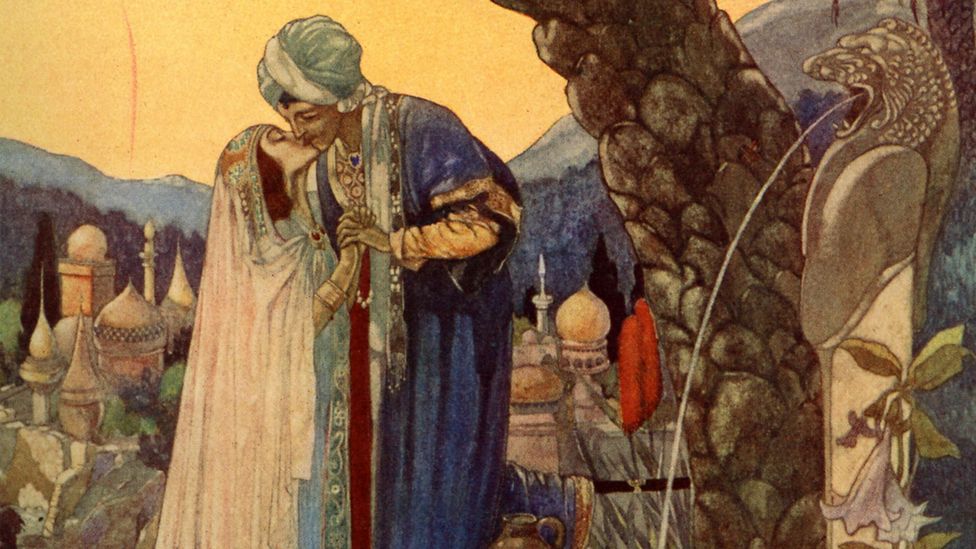
The Rubáiyát of Omár Khayyám entreated 'if y'all are intoxicated with vino, enjoy!/If yous are seated with a lover of thine, savor!', becoming a cult hit (Credit: Alamy)
Is there a danger that carpe diem could just represent a course of escapism, though – that savouring besides many exquisite moments means leaving all your responsibilities backside? 1 of the risks of hedonism is that you tin end up "doing Trainspotting-style heroin overdoses and binge drinking," and that'southward "non going to assistance y'all or anybody else," says Kznaric. "But in the carpe diem tradition, something similar hedonism has never really been so much about backlog, it's been nigh rediscovering the senses, rediscovering direct experience – whether information technology'southward free love or gastronomic exploration."
Life or death
Another thing that stops us from seizing the 24-hour interval is an aversion to facing our ain mortality. "We live in a culture of death deprival, because the advertisement industry tells us that we're forever young," says Krznaric. "But one of the cornerstones of carpe diem thinking for the final two millennia has been that idea of having a taste of death on your mind – because how do nosotros really take action if we think we'll live forever? We'd never practice anything."
"Come to terms with death," wrote Albert Camus. "Thereafter annihilation is possible." Krznaric tried to put this into action while working on Carpe Diem Reclaimed. "I of the new habits I've adopted is what I call a 'death suspension', which sounds slightly macabre but it's nigh spending five minutes a day merely thinking nearly decease, bringing information technology into my life."
In the Middle Ages "there was this connection with death that people had so, that nosotros don't take today" – this is from a 1485 edition of the Danse Macabre (Credit: Alamy)
"Philosophers take come up with lots of what I call 'expiry tasters' – thought experiments for seizing the day. A classic one, going back to the Romans, is the idea of living every day as though it were your last. Some other one is 'live every bit if you've got six months left', which is a more long-term thinking. So in the Buddhist tradition, alive as if life is full of little deaths. That thought of impermanence: your children are just going to abound upwardly once so spend time with them."
It'due south something we need to remind ourselves of today. "Most cultures today have lost the preoccupation with death that was so prevalent in medieval and Renaissance societies, when church walls were covered with frescoes of dancing skeletons, and people kept human skulls on their desks – known as memento mori, Latin for 'remember you must die' – as a reminder that decease could have them at any moment."
"We are better at talking about death than we were," says Krznaric, "but it'due south notwithstanding a pretty taboo topic" (Credit: Alamy)
The 2007 film The Bucket Listing sparked a 'Things to do before you dice' industry, and although Krznaric sees the phenomenon as "a event of our hyper-individualistic Yolo culture," he says in that location is "an interesting existential question hovering behind the film and the frenzied online cult it has spawned: what would y'all do if you lot knew yous had only a set up catamenia left to live?"
Krznaric cites Akira Kurosawa's Ikiru and the dark comedy Harold and Maude every bit powerful reminders of bloodshed, proverb: "There's the culture which distracts us, merely there are encounters yous tin can accept that open your mind to death". And these "can be extraordinarily powerful in awakening our awareness about the shortness of life". Equally the author and philosopher Jean-Paul Sartre put it: "There is only 1 day left, ever starting over: it is given to the states at dawn, and taken away from u.s.a. at dusk."
If you would like to annotate on this story or anything else you accept seen on BBC Civilization, caput over to our Facebook folio or message us on Twitter .
And if y'all liked this story, sign upward for the weekly bbc.com features newsletter , called "If You Only Read half-dozen Things This Week". A handpicked choice of stories from BBC Future, Globe, Culture, Capital and Travel, delivered to your inbox every Fri.
Source: https://www.bbc.com/culture/article/20170517-what-it-really-means-to-seize-the-day
0 Response to "What Language Arts Term Means to Seize the Day"
Postar um comentário