What Major City Was the Battle of Bunker Hill Close to?
| Battle of Bunker Hill | |||||||||
|---|---|---|---|---|---|---|---|---|---|
| Part of the American Revolutionary War | |||||||||
 Death of General Warren at the Battle of Bunker Colina past John Trumbull | |||||||||
| |||||||||
| Belligerents | |||||||||
|
|  Great United kingdom of great britain and northern ireland Great United kingdom of great britain and northern ireland | ||||||||
| Commanders and leaders | |||||||||
 William Prescott Israel Putnam Joseph Warren † John Stark William Prescott Israel Putnam Joseph Warren † John Stark | William Howe Thomas Cuff Sir Robert Pigot James Abercrombie † Henry Clinton Samuel Graves John Pitcairn † Samuel Graves John Pitcairn † | ||||||||
| Forcefulness | |||||||||
| ~two,400[1] | 3,000+[2] | ||||||||
| Casualties and losses | |||||||||
| 115 killed, 305 wounded, 30 captured (20 POWs died) Total: 450[three] | 19 officers killed 62 officers wounded 207 soldiers killed 766 soldiers wounded Total: ane,054 [four] | ||||||||
| class=notpageimage| Location within Massachusetts | |||||||||


The Battle of Bunker Hill was fought on Saturday June 17, 1775 during the Siege of Boston in the starting time stage of the American Revolutionary War.[5] The boxing is named after Bunker Hill in Charlestown, Massachusetts, which was peripherally involved in the battle. It was the original objective of both the colonial and British troops, though the majority of gainsay took place on the adjacent hill which later became known as Breed'southward Colina.[vi] [7]
On June 13, 1775, the leaders of the colonial forces besieging Boston learned that the British were planning to transport troops out from the metropolis to fortify the unoccupied hills surrounding the city, which would give them control of Boston Harbor. In response, 1,200 colonial troops under the command of William Prescott stealthily occupied Bunker Hill and Breed's Colina. During the night, the colonists constructed a strong redoubt on Breed'due south Hill, as well every bit smaller fortified lines beyond the Charlestown Peninsula.[eight]
By daybreak of June 17, the British became aware of the presence of colonial forces on the Peninsula and mounted an attack against them that day. Two assaults on the colonial positions were repulsed with significant British casualties; the 3rd and last attack carried the redoubt afterward the defenders ran out of ammunition. The colonists retreated over Bunker Colina, leaving the British[9] in control of the Peninsula.[10]
The battle was a tactical, though somewhat Pyrrhic, victory for the British,[11] [12] equally information technology proved to be a sobering experience for them; the British incurred many more casualties than the Americans had sustained, including many officers. The battle had demonstrated that inexperienced militia were able to stand upwards to regular regular army troops in boxing. After, the battle discouraged the British from whatever farther frontal attacks against well defended front end lines. American casualties were comparatively much fewer, although their losses included General Joseph Warren and Major Andrew McClary, the terminal casualty of the battle.[13]
The battle led the British to adopt a more cautious planning and maneuver execution in hereafter engagements, which was evident in the subsequent New York and New Jersey campaign, which arguably helped rather than hindered the American forces, as their new arroyo to battle was actually giving the Americans greater opportunity to retreat if defeat was imminent. The costly appointment also convinced the British of the need to hire substantial numbers of Hessian auxiliaries to bolster their strength in the face of the new and formidable Continental Regular army.
Geography
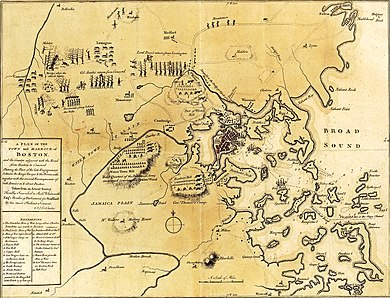
1775 map of the Boston area (contains some inaccuracies)
Boston, situated on a peninsula,[a] was largely protected from close approach by the expanses of water surrounding it, which were dominated by British warships. In the aftermath of the battles of Lexington and Concord on April 19, 1775, the colonial militia, a force of about 15,000 men,[14] had surrounded the town, and effectively besieged it. Nether the control of Artemas Ward, they controlled the only land admission to Boston itself (the Roxbury Neck), but, lacking a navy, were unable even to contest British domination of the waters of the harbor. The British troops, a forcefulness of about 6,000 under the command of General Thomas Gage, occupied the city, and were able to be resupplied and reinforced by bounding main.[xv] In theory, they were thus able to remain in Boston indefinitely.
However, the land across the h2o from Boston independent a number of hills, which could be used to advantage.[b] If the militia could obtain enough artillery pieces, these could be placed on the hills and used to bombard the city until the occupying army evacuated information technology or surrendered. It was with this in mind that the Knox Expedition, led by Henry Knox, later on transported cannon from Fort Ticonderoga to the Boston area.[16]
The Charlestown Peninsula, lying to the northward of Boston, started from a curt, narrow isthmus (known as the Charlestown Cervix) at its northwest and extended about 1 mile (1.6 km) southeastward into Boston Harbor. Bunker Hill, with an summit of 110 anxiety (34 thousand), lay at the northern cease of the peninsula. Breed's Colina, at a height of 62 feet (19 k), was more southerly and nearer to Boston.[17] Although at an advantage due to the summit of Breed'due south Loma and Bunker Loma, information technology also essentially trapped the American soldiers at the superlative.[18] [xix] The settled function of the town of Charlestown occupied flats at the southern end of the peninsula. At its closest approach, less than i,000 feet (300 chiliad) separated the Charlestown Peninsula from the Boston Peninsula, where Copp's Loma was at about the aforementioned summit as Brood's Hill. While the British retreat from Concord had concluded in Charlestown, General Cuff, rather than immediately fortifying the hills on the peninsula, had withdrawn those troops to Boston the day later that battle, turning the entire Charlestown Peninsula into a no man'southward country.[20]

British planning
Throughout May, in response to orders from Cuff requesting support, the British received reinforcements, until they reached a strength of about 6,000 men. On May 25, three generals arrived on HMSCerberus: William Howe, John Burgoyne, and Henry Clinton. Gage began planning with them to break out of the metropolis,[21] finalizing a program on June 12.[22] This plan began with the taking of the Dorchester Cervix, fortifying the Dorchester Heights, and and so marching on the colonial forces stationed in Roxbury. In one case the southern flank had been secured, the Charlestown heights would be taken, and the forces in Cambridge driven away. The attack was set up for June 18.[23]
On June xiii, the Massachusetts Provincial Congress was notified, past express messenger from the Commission of Safety in Exeter, New Hampshire, that a New Hampshire gentleman "of undoubted veracity" had, while visiting Boston, overheard the British commanders making plans to capture Dorchester and Charlestown.[24] On June xv, the Massachusetts Committee of Condom decided that additional defenses needed to exist erected.[25] General Ward directed Full general Israel Putnam to set defenses on the Charlestown Peninsula, specifically on Bunker Loma.[26] [27]
Prelude to battle
Fortification of Breed's Hill

Assortment of American forces for the Battle of Bunker Hill
On the night of June sixteen, colonial Colonel William Prescott led about 1,200 men onto the peninsula in order to prepare positions from which artillery fire could be directed into Boston.[28] This force was made up of men from the regiments of Prescott, Putnam (the unit was commanded by Thomas Knowlton), James Frye, and Ebenezer Bridge.[29] At showtime, Putnam, Prescott, and their engineer, Captain Richard Gridley, disagreed equally to where they should locate their defense. Some work was performed on Bunker Loma, but Breed's Loma was closer to Boston and viewed every bit existence more defensible. Arguably against orders, they decided to build their primary redoubt there.[30] Prescott and his men, using Gridley's outline, began digging a foursquare fortification about 130 feet (40 m) on a side with ditches and earthen walls. The walls of the redoubt were about vi feet (one.8 m) high, with a wooden platform inside on which men could stand up and fire over the walls.[31] [32]
The works on Breed'due south Colina did not go unnoticed by the British. General Clinton, out on reconnaissance that dark, was enlightened of them, and tried to convince Gage and Howe that they needed to prepare to attack the position at daylight. British sentries were likewise aware of the activity, but well-nigh apparently did not think information technology cause for alarm.[33] Then, in the early predawn, around 4 a.m., a sentry on lath HMSLively spotted the new fortification, and notified her helm. Lively opened burn, temporarily halting the colonists' work. Aboard his flagship HMSSomerset, Admiral Samuel Graves awoke, irritated past the gunfire that he had not ordered.[34] He stopped it, only to have General Gage countermand his determination when he became fully aware of the situation in the morning. He ordered all 128 guns in the harbor, every bit well as batteries atop Copp's Hill in Boston, to burn down on the colonial position.[35] The barrage had relatively little effect, as the hilltop fortifications were high enough to frustrate authentic aiming from the ships and far plenty from Copp's Loma to return the batteries there ineffective. The shots that did manage to land, however, were able to kill 1 American soldier and harm the entire supply of water brought for the troops.[36]
The rising dominicus also alerted Prescott to a meaning problem with the location of the redoubt – it could easily exist flanked on either side.[33] He promptly ordered his men to begin constructing a breastwork running downwards the hill to the east, deciding he did not accept the manpower to also build additional defenses to the west of the redoubt.[37]
British preparations
When the British generals met to discuss their options, Full general Clinton, who had urged an attack as early equally possible, preferred an attack start from the Charlestown Neck that would cutting off the colonists' retreat, reducing the process of capturing the new redoubt to one of starving out its occupants. All the same, he was outvoted by the other 3 generals, who were concerned that his plan violated the convention of the time to not permit ane'southward army to become trapped between enemy forces.[38] Howe, who was the senior officer nowadays and would lead the set on, was of the opinion that the colina was "open and easy of rise and in short would exist easily carried."[39] General Burgoyne concurred, arguing that the "untrained rabble" would be no lucifer for their "trained troops".[40] Orders were then issued to prepare the expedition.[41]
When Full general Gage surveyed the works from Boston with his staff, Loyalist Abijah Willard recognized his brother-in-law Colonel Prescott. "Will he fight?" asked Cuff. "[A]s to his men, I cannot answer for them;" replied Willard, "simply Colonel Prescott volition fight you to the gates of hell."[42] Prescott lived up to Willard's give-and-take, merely his men were not then resolute. When the colonists suffered their first casualty, Asa Pollard of Billerica,[43] a young individual killed by cannon burn down, Prescott gave orders to bury the human being apace and quietly, but a large grouping of men gave him a solemn funeral instead, with several deserting shortly thereafter.[42]
It took vi hours for the British to organize an infantry force and to gather up and audit the men on parade. Full general Howe was to pb the major assault, drive around the colonial left flank, and take them from the rear. Brigadier General Robert Pigot on the British left flank would pb the direct assault on the redoubt, and Major John Pitcairn led the flank or reserve force. It took several trips in longboats to transport Howe's initial forces (consisting of nearly one,500 men) to the eastern corner of the peninsula, known as Moulton's Indicate.[44] [45] By ii p.k., Howe's chosen force had landed.[44] However, while crossing the river, Howe noted the large number of colonial troops on top of Bunker Hill. Assertive these to be reinforcements, he immediately sent a bulletin to Gage, requesting additional troops. He and so ordered some of the light infantry to take a forrard position along the eastern side of the peninsula, alerting the colonists to his intended class of activity. The troops then sat downwardly to eat while they waited for the reinforcements.[45]
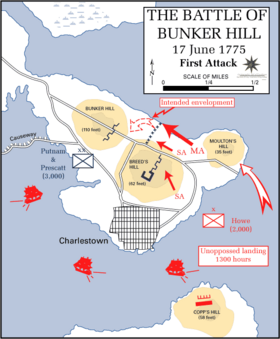
The first British attack on Bunker Hill; shaded areas are hills
Colonists reinforce their positions
Prescott, seeing the British preparations, called for reinforcements. Among the reinforcements were Joseph Warren, the popular young leader of the Massachusetts Committee of Prophylactic, and Seth Pomeroy, an crumbling Massachusetts militia leader. Both of these men held commissions of rank, but chose to serve as infantry.[44] Prescott ordered the Connecticut men under Captain Knowlton to defend the left flank, where they used a crude dirt wall as a breastwork, and topped it with fence rails and hay. They besides constructed 3 small-scale 5-shaped trenches between this dirt wall and Prescott's breastwork. Troops that arrived to reinforce this flank position included about 200 men from the 1st and 3rd New Hampshire regiments, under Colonels John Stark and James Reed. Stark'south men, who did not arrive until subsequently Howe landed his forces (and thus filled a gap in the defense that Howe could have taken advantage of, had he pressed his attack sooner),[46] took positions forth the bastion on the northern end of the colonial position. When low tide opened a gap forth the Mystic River to the northward, they chop-chop extended the fence with a brusk rock wall to the water's edge.[46] [47] Colonel Stark placed a stake about 100 feet (thirty one thousand) in front of the fence and ordered that no one burn down until the regulars passed it.[48] Just prior to the activeness, further reinforcements arrived, including portions of Massachusetts regiments of Colonels Brewer, Nixon, Woodbridge, Fiddling, and Major Moore, as well every bit Callender'southward company of artillery.[49]
Behind the colonial lines, defoliation reigned. Many units sent toward the action stopped before crossing the Charlestown Neck from Cambridge, which was under constant burn from gun batteries to the south. Others reached Bunker Hill, just and then, uncertain about where to go from at that place, milled around. 1 commentator wrote of the scene that "information technology appears to me there never was more than confusion and less command."[50] While General Putnam was on the scene attempting to direct diplomacy, unit commanders often misunderstood or disobeyed orders.[50] [51]
British assault
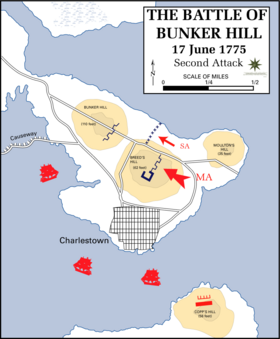
The 2nd British assail on Bunker Hill
By three p.m., the British reinforcements, which included the 47th Regiment of Foot and the 1st Marines, had arrived, and the British were ready to march.[52] Brigadier General Pigot's force, gathering merely southward of Charlestown village, were taking casualties from sniper fire from the settlement, and Howe asked Admiral Graves for assistance in immigration out the snipers. Graves, who had planned for such a possibility, ordered a carcass fired into the village, and and then sent a landing political party to prepare burn to the town.[53] [54] The smoke billowing from Charlestown lent an almost surreal backdrop to the fighting, as the winds were such that the smoke was kept from the field of boxing.[55]
Full general Howe led the light infantry companies and grenadiers in the attack on the American left flank along the track fence, expecting an easy effort against Stark'due south recently arrived troops.[56] His lite infantry were set along the narrow beach, in column formation, in guild to turn the far left flank of the colonial position.[57] The grenadiers were deployed in the centre, lining upward iv deep and several hundred across. Pigot, commanding the 5th, 38th, 43rd, 47th, and 52nd regiments, likewise as Major Pitcairn'southward Marines, were to feint an assail on the redoubt. Just before the British advanced, the American position forth the rails fence was reinforced by two pieces of artillery from Bunker Colina.[58]
Howe had intended the accelerate to be preceded by an artillery bombardment from the field pieces nowadays, still, it was soon discovered that these cannon had been supplied with the wrong quotient of armament, delaying the assault. Attacking Brood'southward Colina presented an array of difficulties; the hay on the hillside had not been harvested, requiring that the regulars marched through waist-high grass which concealed the uneven terrain beneath; the pastureland of the hillside was covered with crisscrossing rails fences hampering the cohesion of marching formations; the regulars were loaded down with gear wholly unnecessary for the attack; and the rut of the afternoon lord's day, compounded past the nearby inferno from Charlestown, presented a environment not conducive for the troops in their wool uniforms to bear an efficient attack.[59] [60]
For their function, to offset their shortage of pulverisation, the colonists withheld their burn until the regulars were inside at least 50 paces of their position. As the regulars closed in range, they suffered heavy casualties from colonial fire. The colonists benefited from the rail argue to steady and aim their muskets, and enjoyed a modicum of cover from return fire. Under this withering fire, the light companies melted abroad and retreated, some as far every bit their boats. James Abercrombie, commanding the Grenadiers, was fatally wounded. Pigot'southward attacks on the redoubt and breastworks fared little better; by stopping and exchanging fire with the colonists, the regulars were fully exposed and suffered heavy losses. They continued to be harried by snipers in Charlestown, and, after seeing what happened to Howe's advance, Pigot ordered a retreat.[61] [62] [63]
The regulars reformed on the field and marched out again, this fourth dimension navigating a field strewn with dead and wounded comrades. This time, Pigot was not to feint; he was to assault the redoubt direct, possibly without the assistance of Howe'southward force. Howe, instead of marching against Stark's position along the embankment, advanced instead against Knowlton'southward position forth the runway fence. The outcome of the 2nd attack was very much the same equally the first. 1 British observer wrote, "Well-nigh of our Grenadiers and Light-infantry, the moment of presenting themselves lost three-fourths, and many nine-tenths, of their men. Some had only eight or nine men a company left ..."[64] Pigot's attack did not bask any greater success than Howe; afterward near thirty minutes of firing ineffective volleys at the colonial position,[65] Pigot ordered a retreat.[66] The second attack had failed.
Meanwhile, in the rear of the colonial forces, confusion continued to reign. General Putnam tried, with simply limited success, to transport additional troops from Bunker Loma to the forrad positions on Breed's Colina to support the embattled regiments.[67] [68] One colonial observer wrote to Samuel Adams later, "it appears to me that there was never more than confusion and less command". Some companies and leaderless groups of men moved toward the field; others retreated. They were running depression on powder and ammunition, and the colonial regiments suffered from a hemorrhage of deserters; by the time the tertiary assail came, there were merely 700-800 men left on Brood'south Colina, with only 150 in the redoubt.[69] [lxx] John Chester, a Connecticut captain, seeing an entire company in retreat, ordered his company to aim muskets at that company to halt its retreat; they turned about and headed back to the battlefield.[71]
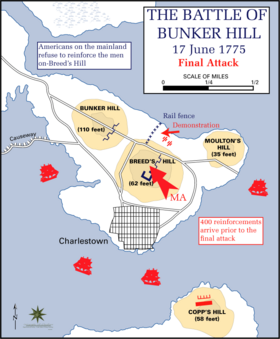
The tertiary and final British assault on Bunker Colina
The British rear was also in disarray. Wounded soldiers that were mobile had made their style to the landing areas and were beingness ferried back to Boston, while the wounded lying on the field of battle were the source of moans and cries of pain.[72] Howe, committing to a third attack, sent word to Clinton in Boston for additional troops. Clinton, who had observed the offset ii attacks, sent around 400 men from the 2nd Marines and the 63rd Pes, and followed himself to help rally the troops. In addition to these reserves, he convinced around 200 walking wounded to form up for the third attack.[73]
The third assault was to concentrate squarely on the redoubt, with only a feint on the colonists' flank. Howe ordered his men to remove their heavy packs and leave all unnecessary equipment behind. Howe arrayed his forces in column formation rather than the extended club of the kickoff two assaults, exposing fewer men along the front to colonial fire.[74] The third assault, this fourth dimension fabricated at the point of the bayonet, successfully carried the redoubt, however the final volleys of fire from the colonists cost the life of Major Pitcairn.[75] The defenders had run out of ammunition, reducing the battle to close combat. The reward turned to the British, as their troops were equipped with bayonets on their muskets, while about of the colonists were not. Colonel Prescott, 1 of the last men to leave the redoubt, parried bayonet thrusts with his unremarkably ceremonial sabre.[76] It is during the retreat from the redoubt that Joseph Warren was killed.[77]
The retreat of much of the colonial forces from the peninsula was made possible in function past the controlled withdrawal of the forces along the rail debate, led by John Stark and Thomas Knowlton, which prevented the encirclement of the hill. Their disciplined retreat, described by Burgoyne as "no flight; information technology was fifty-fifty covered with bravery and armed forces skill", was and then effective that nigh of the wounded were saved;[78] most of the prisoners taken by the British were mortally wounded.[78] General Putnam attempted to reform the troops on Bunker Hill; withal the flight of the colonial forces was so rapid that artillery pieces and entrenching tools had to be abased. The colonists suffered near of their casualties during the retreat on Bunker Hill. By v p.m., the colonists had retreated over the Charlestown Neck to fortified positions in Cambridge, and the British were in command of the peninsula.[79]
Backwash
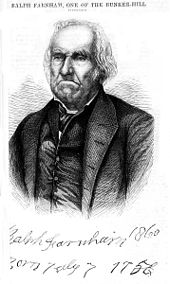
Ralph Farnham, one of the last survivors
The British had taken the ground simply at a great loss; they had suffered 1,054 casualties (226 dead and 828 wounded), with a disproportionate number of these officers. The casualty count was the highest suffered by the British in any single encounter during the entire war.[80] General Clinton, echoing Pyrrhus of Epirus, remarked in his diary that "A few more such victories would accept soon put an end to British dominion in America."[11] British dead and wounded included 100 deputed officers, a pregnant portion of the British officer corps in N America.[81] Much of Full general Howe's field staff was among the casualties.[82] General Gage, in his written report subsequently the battle, reported the post-obit officeholder casualties (list lieutenants and above by name):[83]
- ane lieutenant colonel killed
- 2 majors killed, 3 wounded
- 7 captains killed, 27 wounded
- 9 lieutenants killed, 32 wounded
- fifteen sergeants killed, 42 wounded
- ane drummer killed, 12 wounded
The colonial losses were about 450, of whom 140 were killed. Most of the colonial losses came during the withdrawal. Major Andrew McClary was technically the highest ranking colonial officeholder to die in the boxing; he was hit past cannon fire on Charlestown Neck, the last person to be killed in the boxing. He was later commemorated past the dedication of Fort McClary in Kittery, Maine.[84] A serious loss to the Patriot crusade, however, was the death of Dr. Joseph Warren. He was the President of Massachusetts' Provincial Congress, and he had been appointed a Major Full general on June xiv. His commission had not still taken outcome when he served as a volunteer private three days later on at Bunker Loma.[85] Merely thirty men were captured by the British, most of them with grievous wounds; xx died while held prisoner. The colonials also lost numerous shovels and other entrenching tools, also every bit v out of the six cannon they had brought to the peninsula.[86] [87]
Political consequences
When news of the battle spread through the colonies, information technology was reported as a colonial loss, as the basis had been taken by the enemy, and significant casualties were incurred. George Washington, who was on his way to Boston equally the new commander of the Continental Army, received news of the boxing while in New York City. The written report, which included casualty figures that were somewhat inaccurate, gave Washington hope that his army might prevail in the conflict.[88]
We have ... learned one melancholy truth, which is, that the Americans, if they were equally well commanded, are full as good soldiers as ours.[89]
A British officeholder in Boston, after the battle
The Massachusetts Commission of Prophylactic, seeking to repeat the sort of propaganda victory information technology won following the battles at Lexington and Concord, commissioned a study of the boxing to send to England. Their report, notwithstanding, did not reach England before Cuff's official account arrived on July xx. His written report unsurprisingly caused friction and argument between the Tories and the Whigs, only the casualty counts alarmed the military institution, and forced many to rethink their views of colonial military capability.[90] Rex George's attitude toward the colonies hardened, and the news may have contributed to his rejection of the Continental Congress' Olive Branch Petition, the final noun political endeavor at reconciliation. Sir James Adolphus Oughton, part of the Tory majority, wrote to Lord Dartmouth of the colonies, "the sooner they are made to Taste Distress the sooner will [Crown control over them] be produced, and the Effusion of Claret be put a stop to."[91] Most a month after receiving Cuff's report the Proclamation of Rebellion would exist issued in response; this hardening of the British position would as well lead to a hardening of previously weak support for the rebellion, especially in the southern colonies, in favor of independence.[91]
Gage's report had a more than direct issue on his ain career. His dismissal from function was decided just iii days after his report was received, although General Howe did non supersede him until October 1775.[92] Gage wrote another written report to the British Cabinet, in which he repeated earlier warnings that "a large army must at length be employed to reduce these people", that would require "the hiring of foreign troops".[93]
Analysis
Much has been written in the wake of this battle over how information technology was conducted. Both sides made strategic and tactical missteps which could have contradistinct the outcome of the battle. While retrospect often gives a biased view, some things seem to exist apparent afterwards the battle that might reasonably accept been within the accomplish of the command of the day.
Years later the battle, and after Israel Putnam was dead, General Dearborn published an business relationship of the battle in Port Folio magazine, accusing General Putnam of inaction, cowardly leadership and failing to supply reinforcements during the boxing, which subsequently sparked a long lasting and major controversy among veterans of the state of war, diverse friends, family members and historians.[94] [c] People were shocked by the rancor of the attack, and this prompted a forceful response from defenders of Putnam, including such notables as John and Abigail Adams. It too prompted Putnam'southward son, Daniel Putnam, to defend his father using a letter of cheers written by George Washington, and statements from Colonel John Trumbull and Judge Thomas Grosvenor in Putnam'due south defence force.[95] Historian Harold Murdock wrote that Dearborn'southward business relationship "abounds in absurd misstatements and amazing flights of imagination." The Dearborn attack received considerable attention because at the time he was in the middle of considerable controversy himself. He had been relieved of one of the top commands in the State of war of 1812 due to his mistakes. He had also been nominated to serve as Secretary of War by President James Monroe, only was rejected past the United States Senate (which was the offset fourth dimension that the Senate had voted against confirming a presidential cabinet choice).[96] [97] [98] [99] Several contradictory accounts of the event sparked discourse, but New Englanders attempted to resolve conflicts past suggesting to cock memorials dedicated to Bunker Hill rather than a specific person.[95]
Disposition of Colonial forces
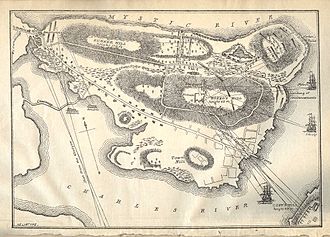
A historic map of Bunker Hill featuring military notes
The colonial regiments, while nominally under the overall command of General Ward, with Full general Putnam and Colonel Prescott leading in the field, oftentimes acted quite independently.[100] This was evident in the opening stages of the battle, when a tactical decision was fabricated that had strategic implications: after deliberating with General Putnam and Colonel Gridley, Colonel Prescott and his staff, apparently in contravention of orders, decided to fortify Breed'due south Hill rather than Bunker Hill.[101] The fortification of Brood's Hill was more militarily provocative; information technology would have put offensive arms closer to Boston, direct threatening the urban center.[102] It likewise exposed the forces there to the possibility of beingness trapped, every bit they probably could non properly defend against attempts by the British to land troops and have control of Charlestown Cervix. If the British had taken that footstep, they might have had a victory with many fewer casualties.[103] The colonial fortifications were haphazardly arrayed; it was not until the morning that Prescott discovered the redoubt could be easily flanked,[33] compelling the hasty construction of a track fence. Furthermore, the colonists did non accept the manpower to defend to the west.[37]
Manpower was a further trouble on Breed'south Hill; toward the northern end of the colonial position the defenses were sparse and could have been easily exploited by the British (as they had already landed), had reinforcements not arrived in time.[46] While the forepart lines of the colonial forces were more often than not well-managed, the scene behind them, specially once the fighting began, was significantly disorganized, due at least in function due to a poor chain of command and logistical organization. One commentator wrote: "it appears to me in that location never was more than confusion and less command."[l] Just some of the militias operated direct under Ward'due south and Putnam'due south say-so,[104] and some commanders directly disobeyed orders, remaining at Bunker Hill rather than committing to the defense of Breed'south Colina once fighting began. Subsequent to the battle, several officers were subjected to courtroom martial and cashiered.[105]
Once combat began, desertion was a chronic issue for the colonial troops. By the time of the third British assault, there were only 700-800 troops left, with only 150 in the redoubt.[69] Colonel Prescott was of the stance that the third set on would have been repulsed, had his forces in the redoubt been reinforced with either more men, or if more supplies of armament and powder had been brought forward from Bunker Hill.[106] Despite these issues, the withdrawal of the colonial forces was generally well-managed, recovering most of their wounded in the process, and elicited praise from British generals such as Burgoyne.[78] However, the speed of the withdrawal precipitated leaving backside their artillery and entrenching tools.[79]
Disposition of British forces
The British leadership, for its role, acted slowly in one case the works on Brood's Hill were spotted. Information technology was two p.chiliad. when the troops were set up for the assault, roughly ten hours after the Lively first opened fire. This leisurely pace gave the colonial forces ample time to reinforce the flanking positions that would have otherwise been poorly defended and vulnerable.[107] Cuff and Howe decided that a frontal set on on the works would be a simple matter, although an encircling move (i.e. gaining control of Charlestown Neck) would have given them a more rapid and resounding victory.[103] (This move would not accept been without risks of its own, equally the colonists could have made holding the Neck expensive with fire from the high footing in Cambridge.) However, the British leadership was excessively optimistic, assertive that "two regiments were sufficient to beat the forcefulness of the province".[108]

View of the Attack on Bunker's Hill with the Burning of Charlestown, by Lodge
The British assault was further delayed when the inefficiencies engendered by peacetime bore fruit; the artillery bombardment that was to have preceded the assail did not transpire, equally it was discovered the field guns had been supplied with the incorrect caliber of armament.[59] In one case in the field, Howe, rather than focusing on the redoubt, twice opted to dilute the forcefulness attacking the redoubt with flanking assaults against the colonial left. The formations the British used were non conducive to a successful assail; arrayed in long lines and weighed downwards past unnecessary heavy gear, many of the troops were immediately vulnerable to colonial fire, which resulted in heavy casualties in the initial attacks. The impetus of any British attack was further diluted when officers opted to concentrate on firing repeated volleys which were simply captivated past the earthworks and rail fences. It was only with the third attack, when the forces were arrayed in deep columns; the troops were ordered to leave all unnecessary gear backside; the attacks were to be at the betoken of the bayonet;[74] and the flanking attack was merely a feint,[109] with the principal force (now reinforced) squarely targeted the redoubt, that the try succeeded.[110]
Following the taking of the peninsula, the British arguably had a tactical advantage that they could have used to press into Cambridge. General Clinton proposed this to Howe; having just led three assaults with grievous casualties (with most of his field staff among them), he declined the idea.[111] The colonial war machine leaders somewhen recognized Howe equally a tentative conclusion-maker, to his detriment; in the backwash of the Battle of Long Isle (1776), he again had tactical advantages that might have delivered Washington's ground forces into his easily, but again refused to human activity.[112]
Historian John Ferling maintains that had General Cuff used the Royal Navy to secure the narrow neck to the Charleston peninsula, cutting the Americans off from the mainland, he could have accomplished a far less costly victory, but he was motivated by revenge over patriot resistance at the Battles of Lexington and Concord and relatively heavy British losses, and also felt that the colonial militia were completely untrained and could be overtaken with little effort, opting for a frontal set on.[113]
"The whites of their eyes"
The famous gild "Don't fire until you meet the whites of their eyes" was popularized in stories nearly the battle of Bunker Colina.[ citation needed ] It is uncertain as to who said information technology there, since diverse histories, including eyewitness accounts,[114] attribute it to Putnam, Stark, Prescott, or Gridley, and it may have been said first by one, and repeated past the others.[115] Information technology was also not an original statement. The idea dates originally to the full general-rex Gustavus Adolphus (1594–1632) who gave standing orders to his musketeers: "never to give fire, till they could see their ain paradigm in the pupil of their enemy'due south eye".[116] Gustavus Adolphus's armed services teachings were widely admired and imitated and caused this saying to exist often repeated. It was used by Full general James Wolfe on the Plains of Abraham, when his troops defeated Montcalm'due south army on September 13, 1759.[117] The primeval like quote came from the Battle of Dettingen on June 27, 1743, where Lieutenant-Colonel Sir Andrew Agnew of Lochnaw warned his Regiment, the Majestic Scots Fusiliers, not to fire until they could "see the white of their east'en."[118] The phrase was also used past Prince Charles of Prussia in 1745, and repeated in 1755 by Frederick the Great, and may accept been mentioned in histories the colonial military leaders were familiar with.[119] Whether or not it was actually said in this battle, information technology was clear that the colonial war machine leadership were regularly reminding their troops to concord their burn down until the moment when it would take the greatest outcome, peculiarly in situations where their ammunition would exist limited.[120]
Notable participants

According to the John Trumbull painting, this flag of New England was carried by the colonists during the boxing.
A significant number of notable American patriots fought in this boxing. Henry Dearborn and William Eustis, for instance, went on to distinguished military and political careers; both served in Congress, the Chiffonier, and in diplomatic posts. Others, like John Brooks, Henry Burbeck, Christian Febiger, Thomas Knowlton, and John Stark, became well known for afterwards actions in the war.[121] [122] Stark became known as the "Hero of Bennington" for his function in the 1777 Battle of Bennington. Free African-Americans too fought in the boxing; notable examples include Barzillai Lew, Salem Poor, and Peter Salem.[123] [124] Another notable participant was Daniel Shays, who later on became famous for his regular army of protest in Shays' Rebellion.[125] Israel Potter was immortalized in Israel Potter: His 50 Years of Exile, a novel by Herman Melville.[126] [127] Colonel John Paterson commanded the Massachusetts Starting time Militia, served in Shays' Rebellion, and became a congressman from New York.[128] Lt. Col. Seth Read, who served under John Paterson at Bunker Hill, went on to settle Geneva, New York and Erie, Pennsylvania, and was said to have been instrumental in the phrase E pluribus unum being added to U.S. coins.[129] [130] [131] [132] George Claghorn of the Massachusetts militia was shot in the knee at Bunker Colina and went on subsequently the war to become the chief builder of the USS Constitution, a.k.a. "Old Ironsides", which is the oldest naval vessel in the globe that is still commissioned and afloat.[133] [134]
Notable British participants in the battle were: Lt. Col. Samuel Birch, Major John Small, Lord Rawdon, Full general William Howe, Major John Pitcairn and Full general Henry Clinton.
Commemorations
John Trumbull'southward painting, The Expiry of General Warren at the Battle of Bunker Hill (displayed in lede), was created every bit an allegorical depiction of the boxing and Warren's death, not as an actual pictorial recording of the event. The painting shows a number of participants in the boxing including a British officer, John Small, amid those who stormed the redoubt, yet came to be the one holding the mortally wounded Warren and preventing a beau redcoat from bayoneting him. He was friends of Putnam and Trumbull. Other fundamental figures include Andrew McClary who was the final man to fall in the battle.[135]
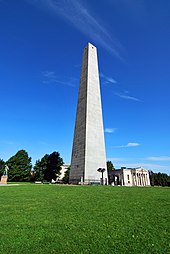
The Bunker Hill Monument is an obelisk that stands 221 anxiety (67 m) high on Brood'due south Hill. On June 17, 1825, the fiftieth anniversary of the battle, the cornerstone of the monument was laid by the Marquis de Lafayette and an address delivered by Daniel Webster.[136] [137] The Leonard P. Zakim Bunker Colina Memorial Span was specifically designed to evoke this monument.[138] There is also a statue of William Prescott showing him calming his men downwards.

The National Park Service operates a museum defended to the boxing about the monument, which is part of the Boston National Historical Park.[139] A cyclorama of the battle was added in 2007 when the museum was renovated.[140]
In nearby Cambridge, a pocket-size granite monument just north of Harvard M bears this inscription: "Hither assembled on the night of June 16, 1775, 1200 Continental troops under command of Colonel Prescott. Later prayer by President Langdon, they marched to Bunker Hill." See footnote for picture.[141] (Samuel Langdon, a Congregational minister, was Harvard'southward 11th president.)[142] Another pocket-sized monument nearby marks the location of the Committee of Safe, which had go the Patriots' provisional government equally Tories left Cambridge.[143] These monuments are on the lawn to the west of Harvard's Littaeur Center, which is itself the due west of Harvard's huge Science Heart. See footnote for map.[144]

Bunker Hill Day, observed every June 17, is a legal holiday in Suffolk Canton, Massachusetts (which includes the metropolis of Boston), likewise as Somerville in Middlesex County. Prospect Hill, site of colonial fortifications overlooking the Charlestown Neck, is now in Somerville, which was previously part of Charlestown.[145] [146] State institutions in Massachusetts (such as public institutions of college teaching) in Boston besides celebrate the holiday.[147] [148] However, the state's FY2011 budget requires that all state and municipal offices in Suffolk County be open on Bunker Hill 24-hour interval and Evacuation Day.[149]
On June 16 and 17, 1875, the centennial of the boxing was celebrated with a military parade and a reception featuring notable speakers, among them Full general William Tecumseh Sherman and Vice President Henry Wilson. It was attended by dignitaries from across the country.[150] Celebratory events likewise marked the sesquicentennial (150th ceremony) in 1925 and the bicentennial in 1975.[151] [152]
Over the years the Boxing of Bunker Loma has been commemorated on four U.S. Postage stamps.[153]

Issue of 1959 Issue of 1975 Consequence of 1968 Issue of 1968
Left stamp depicts Battle of Bunker Loma battle flag and Monument
Left-eye, depicts John Trumbull'south painting of the boxing
Right-middle depicts item of Trumbull's painting
Right depicts image of Bunker Loma boxing flag
See also
- List of American Revolutionary War battles
- American Revolutionary War §Early on Engagements. The Battle of Bunker Hill placed in sequence and strategic context.
- List of Continental Forces in the American Revolutionary War
- List of British Forces in the American Revolutionary State of war
- Dr. John Hart, Regimental Surgeon of Col Prescott's Regiment who treated the wounded at Bunker Hill
- Royal Welch Fusiliers
- USSBunker Hill
Notes
- ^ 18th century Boston was a peninsula. Primarily in the 19th century, much state around the peninsula was filled, giving the modernistic metropolis its present geography. See the history of Boston for details.
- ^ Visitors to Boston, upon seeing the nearby hills, may conclude that they are too low. The hills were once higher, but were lowered past excavations to obtain landfill used to expand Boston in the 19th century.
- ^ In 1822 Dearborn wrote an bearding plea in the Boston Patriot to urge the purchase the site of the Bunker Hill battleground which was currently listed for sale.[94]
References
- ^ Chidsey p. 122 counts 1,400 in the night-time fortification work. Frothingham is unclear on the number of reinforcements arriving but before the battle breaks out. In a footnote on p. 136, also every bit on p. 190, he elaborates the difficulty in getting an accurate count.
- ^ Chidsey p. xc says the initial force requested was 1,550, but Howe requested and received reinforcements earlier the battle began. Frothingham p. 137 puts the total British contingent likely to be over 3,000. Furthermore, according to Frothingham p. 148, additional reinforcements arrived from Boston after the second attack was repulsed. Frothingham, p. 191 notes the difficulty in attaining an authentic count of British troops involved.
- ^ Chidsey, p. 104
- ^ Frothingham pp. 191, 194.
- ^ James Fifty. Nelson, With Fire and Sword: The Boxing of Bunker Hill and the Beginning of the American Revolution (2011)
- ^ Borneman, Walter R. American Leap: Lexington, Concord, and the Road to Revolution, p. 350, Little, Brown and Visitor, New York, Boston, London, 2014. ISBN 978-0-316-22102-three.
- ^ Hubbard, Robert Ernest. Major General Israel Putnam: Hero of the American Revolution, p. 85, McFarland & Company, Inc., Jefferson, Due north Carolina, 2017. ISBN 978-1-4766-6453-8.
- ^ Hubbard, Robert Ernest. Major General Israel Putnam: Hero of the American Revolution, pp. 85–87, McFarland & Company, Inc., Jefferson, North Carolina, 2017. ISBN 978-1-4766-6453-8.
- ^ Withington, Robert (June 1949). "A French Annotate on the Battle of Bunker Colina". The New England Quarterly. 22 (2): 235–240. doi:ten.2307/362033. ISSN 0028-4866. JSTOR 362033.
- ^ Hubbard, Robert Ernest. Major General State of israel Putnam: Hero of the American Revolution, pp. 87–95, McFarland & Company, Inc., Jefferson, Northward Carolina, 2017. ISBN 978-i-4766-6453-eight.
- ^ a b Clinton, p. nineteen. General Clinton'south remark is an echoing of Pyrrhus of Epirus's original sentiment afterwards the Battle of Heraclea, "one more such victory and the crusade is lost".
- ^ "Battle of Bunker Loma". Encyclopædia Britannica. Encyclopædia Britannica, Inc. December 8, 2016. Retrieved January 25, 2016.
Although the British eventually won the battle, it was a Pyrrhic victory that lent considerable encouragement to the revolutionary crusade.
- ^ Hubbard, Robert Ernest. Major General Israel Putnam: Hero of the American Revolution, pp. 94–95, McFarland & Visitor, Inc., Jefferson, North Carolina, 2017. ISBN 978-ane-4766-6453-8.
- ^ Chidsey, p. 72 New Hampshire 1,200, Rhode Island one,000, Connecticut 2,300, Massachusetts eleven,500
- ^ Alden, p. 178
- ^ Martin, James Kirby (1997). Bridegroom Arnold: Revolutionary Hero. New York: New York University Printing. p. 73. ISBN978-0-8147-5560-0. OCLC 36343341.
- ^ Chidsey p. 91 has an historic map showing elevations.
- ^ Withington, Robert (1949). "A French Comment on the Boxing of Bunker Colina". The New England Quarterly. 2: 235–240 – via JSTOR.
- ^ Adams, Charles Francis (1896). "The Battle of Bunker Colina". The American Historical Review. 1: 401–413 – via JSTOR.
- ^ French, p. 220
- ^ French, p. 249
- ^ Brooks, p. 119
- ^ Ketchum, pp. 45–46
- ^ Ketchum, p. 47
- ^ Ketchum, pp. 74–75
- ^ French, p. 255
- ^ Hubbard, Robert Ernest. Major General Israel Putnam: Hero of the American Revolution, p. 84, McFarland & Company, Inc., Jefferson, Due north Carolina, 2017. ISBN 978-one-4766-6453-eight.
- ^ Frothingham, pp. 122–123
- ^ Ketchum, pp. 102, 245
- ^ Frothingham, pp. 123–124
- ^ Frothingham, p. 135
- ^ Hubbard, Robert Ernest. Major General State of israel Putnam: Hero of the American Revolution, pp. 87–88, McFarland & Visitor, Inc., Jefferson, North Carolina, 2017. ISBN 978-1-4766-6453-eight.
- ^ a b c Ketchum, p. 115
- ^ Frothingham, p. 125
- ^ Brooks, p. 127
- ^ Middlekauff, Robert (2005). The Glorious Crusade: The American Revolution, 1763-1789. New York, NY: Oxford University Press. p. 290. ISBN0-19-516247-i. OCLC 55960833.
- ^ a b Ketchum, p. 117
- ^ Middlekauff, Robert (2005). The Glorious Cause: The American Revolution, 1763-1789. New York, NY: Oxford University Printing. p. 293. ISBN0-19-516247-ane. OCLC 55960833.
- ^ Ketchum, pp. 120–121
- ^ Forest, p. 54
- ^ Ketchum, p. 122
- ^ a b Graydon, p. 424
- ^ Chidsey, p. 84
- ^ a b c Frothingham, p. 133
- ^ a b Ketchum, p. 139
- ^ a b c Ketchum, p 143
- ^ Chidsey p. 93
- ^ Chidsey p. 96
- ^ Frothingham, p. 136
- ^ a b c Ketchum, p. 147
- ^ Hubbard, Robert Ernest. Major General Israel Putnam: Hero of the American Revolution, pp. 92–93, McFarland & Company, Inc., Jefferson, North Carolina, 2017. ISBN 978-1-4766-6453-8.
- ^ Ketchum, pp. 152–153
- ^ Ketchum, pp. 151–152
- ^ Middlekauff, Robert (2005). The Glorious Crusade: The American Revolution, 1763-1789. New York, NY: Oxford University Press. p. 296. ISBN0-19-516247-1. OCLC 55960833.
- ^ Frothingham, pp. 144–145
- ^ Ketchum, p. 152
- ^ Fusillers, Mark Urban p38
- ^ Kurtz, Henry I. Men of State of war: Essays on American Wars and Warriors, p. 31, Xlibris Corporation, 2006.
- ^ a b Philbrick, Nathaniel. Bunker Hill: A Metropolis, A Siege, A Revolution, p. 219-220, New York: Viking Press, 2013.
- ^ Kurtz, p. 29
- ^ Ketchum, p. 160
- ^ Kurtz, p. 31-33
- ^ Frothingham, pp. 141–142
- ^ Ketchum, p. 161
- ^ Kurtz, p. 33
- ^ Ketchum, p. 162
- ^ Frothingham, p. 146
- ^ Hubbard, Robert Ernest. Major General State of israel Putnam: Hero of the American Revolution, p. 92, McFarland & Company, Inc., Jefferson, N Carolina, 2017. ISBN 978-1-4766-6453-8.
- ^ a b Kurtz, p. thirty-35
- ^ Hubbard, Robert Ernest. Major General Israel Putnam: Hero of the American Revolution, pp. 92–95, McFarland & Company, Inc., Jefferson, North Carolina, 2017. ISBN 978-1-4766-6453-8.
- ^ Ketchum, pp. 165–166
- ^ Ketchum, p. 163
- ^ Ketchum, p. 164
- ^ a b Kurtz p. 35
- ^ Chidsey p. 99
- ^ Frothingham, p. 150
- ^ Frothingham, p. 151
- ^ a b c Ketchum, p. 181
- ^ a b Frothingham, pp. 151–152
- ^ Brooks, p. 237
- ^ Brooks, pp. 183–184
- ^ Frothingham, pp. 145, 196
- ^ Frothingham, pp. 387–389 lists the officeholder casualties by proper noun, equally well every bit this summary
- ^ Bardwell, p. 76
- ^ Ketchum, p. 150
- ^ Ketchum, p. 255
- ^ Hubbard, Robert Ernest. Major General State of israel Putnam: Hero of the American Revolution, pp. 94–96, McFarland & Company, Inc., Jefferson, North Carolina, 2017. ISBN 978-1-4766-6453-eight.
- ^ Ketchum, pp. 207–208
- ^ Ketchum, p. 209
- ^ Ketchum, pp. 208–209
- ^ a b Ketchum, p. 211
- ^ Ketchum, p. 213
- ^ Scheer, p. 64
- ^ a b Cray, 2001
- ^ a b Cray, Robert E. (2001). "Bunker Hill Refought: Retentiveness Wars and Partisan Conflicts, 1775-1825". Historical Journal of Massachusetts – via Proquest.
- ^ Purcell, 2010, pp.164-168
- ^ Ketchum, Richard Thou. The Boxing for Bunker Hill, p. 178, The Cresset Press, London, England, 1963.
- ^ Murdock, Harold. Bunker Hill, Notes and Queries on a Famous Battle, Kessinger Publishing, LLC, 2010. ISBN 1163174912,
- ^ Hubbard, Robert Ernest. Major General State of israel Putnam: Hero of the American Revolution, pp. 191–92, McFarland & Company, Inc., Jefferson, North Carolina, 2017 ISBN 978-1-4766-6453-8.
- ^ Frothingham, p. 131
- ^ Frothingham, p. 19
- ^ Hubbard, Robert Ernest. Major General Israel Putnam: Hero of the American Revolution, p. 87, McFarland & Visitor, Inc., Jefferson, Northward Carolina, 2017 ISBN 978-i-4766-6453-8.
- ^ a b Frothingham, p. 155
- ^ Frothingham, pp. 158–159
- ^ French, pp. 274–276
- ^ Frothingham, p. 153
- ^ French, pp. 263–265
- ^ Frothingham, p. 156
- ^ French, p. 277
- ^ Frothingham, p. 148
- ^ Frothingham pp. 152–153
- ^ Jackson, p. 20
- ^ Ferling, 2015, p. 127-129
- ^ Lewis, John East., ed. The Mammoth Book of How it Happened. London: Robinson, 1998. Print. P. 179
- ^ Hubbard, Robert Ernest. Major Full general State of israel Putnam: Hero of the American Revolution, p. 97, McFarland & Company, Inc., Jefferson, Due north Carolina, 2017 ISBN 978-1-4766-6453-8.
- ^ Joannis Schefferi, "Memorabilium Sueticae Gentis Exemplorum Liber Singularis" (1671) p. 42
- ^ R. Reilly, The Rest to Fortune: The Life of Major-General James Wolfe (1960), p. 324
- ^ Anderson, p. 679
- ^ Winsor, p. 85
- ^ French, pp. 269–270
- ^ Abbatt, p. 252
- ^ Ketchum, pp. 132,165
- ^ Woodson, p. 204
- ^ Ketchum, p. 260
- ^ Richards, p. 95
- ^ Ketchum, p. 257
- ^ Melville
- ^ Biographical Directory of the United states of america
- ^ Buford, 1895, Preface
- ^ Marvin, p. 425, 436
- ^ "Massachusetts Coppers 1787–1788: Introduction". Academy of Notre Dame. Archived from the original on Nov eight, 2007. Retrieved October 9, 2007.
- ^ "eastward pluribus unum FAQ #7". www.treas.gov. Retrieved September 29, 2007. [ permanent expressionless link ]
- ^ Wheeler, O. Keith (January 30, 2002). "Private Summary for COL. GEORGE CLAGHORN". Retrieved October 10, 2012.
- ^ HMSVictory is the oldest commissioned vessel by iii decades; withal, Victory has been in dry dock since 1922. "HMS Victory Service Life". HMS Victory website. Archived from the original on September 24, 2013. Retrieved Oct 14, 2012.
- ^ Bunce, p. 336
- ^ Hayward, p. 322
- ^ Clary
- ^ MTA Bridges
- ^ Bunker Colina Museum
- ^ McKenna
- ^ "Album Annal". Picasaweb.google.com . Retrieved November 19, 2017.
- ^ "Archived copy". Archived from the original on January one, 2013. Retrieved 2013-12-31 .
{{cite web}}: CS1 maint: archived copy every bit title (link) - ^ Committee of Safety (American Revolution)
- ^ "Harvard University Campus Map". Map.harvard.edu. Archived from the original on January 6, 2013. Retrieved Nov nineteen, 2017.
- ^ MA List of legal holidays
- ^ Somerville Ecology Services Guide
- ^ University of Massachusetts, Boston, observed holidays
- ^ Bunker Hill 24-hour interval closings
- ^ "Commonwealth of Massachusetts FY2011 Budget, Exterior Department five". Mass.gov. July xiv, 2010. Retrieved August 6, 2010.
- ^ Run into the Centennial Volume for a complete description of the events.
- ^ Sesquicentennial celebration
- ^ New York Times, June 15, 1975
- ^ Scotts 2008 United States stamp catalogue
Bibliography
Major sources Most of the information about the battle itself in this article comes from the following sources.
- Brooks, Victor (1999). The Boston Entrada. Conshohocken, PA: Combined Publishing. ISBN1-58097-007-9. OCLC 42581510.
- Chidsey, Donald Barr (1966). The Siege of Boston. Boston, MA: Crown. OCLC 890813.
- Frothingham, Jr, Richard (1851). History of the Siege of Boston and of the Battles of Lexington, Hold, and Bunker Hill, Second Edition. Boston, MA: Charles C. Little and James Brown. OCLC 2138693.
- French, Allen (1911). The Siege of Boston. New York: Macmillan. OCLC 3927532.
- Ketchum, Richard (1999). Decisive Day: The Battle of Bunker Hill. New York: Owl Books. ISBN0-385-41897-3. OCLC 24147566. (Paperback: ISBN 0-8050-6099-5)
- Nelson , James L. With Fire and Sword: The Battle of Bunker Hill and the Beginning of the American Revolution (2011) excerpt
- Philbrick, Nathaniel. Bunker Hill: A City, a Siege, a Revolution (New York: Viking, 2013) excerpt
Pocket-size sources Specific facts not necessarily covered by the major sources come from the following sources.
- Buford, Mary Hunter (1895). Seth Read, Lieut.-Col. Continental Army; Pioneer at Geneva, New York, 1787, and at Erie, Penn., June, 1795. His Ancestors and Descendants. Boston, Mass. pp. 167 Pages on CD in PDF Format.
- Bunce, Oliver Bell (1870). The romance of the revolution: being true stories of the adventures, romantic incidents, hairbreath escapes, and heroic exploits of the days of '76. Philadelphia: Porter & Coates. p. 337. OCLC 3714510.
- Abbatt, William, ed. (1883). The Magazine of American History with Notes and Queries, volume 8. A.S. Barnes. OCLC 1590082.
- Alden, John R (1989). A History of the American Revolution. Da Capo. ISBN0-306-80366-6.
- Anderson, William (1863). The Scottish Nation: Or, The Surnames, Families, Literature, Honours, and Biographical History of the People of Scotland, volume two. Fullarton. OCLC 1290413.
- Bardwell, John D (2005). Quondam Kittery. Arcadia Publishing. ISBN978-0-7385-2476-four.
- Clinton, Henry (1954). Willcox, William B. (ed.). The American Rebellion: Sir Henry Clinton's Narrative of His Campaigns, 1775–1782. Yale University Printing. OCLC 1305132.
- Graydon, Alexander (1846). Littell, John Stockton (ed.). Memoirs of His Ain Fourth dimension: With Reminiscences of the Men and Events of the Revolution. Philadelphia: Lindsay & Blakiston. OCLC 1557096.
- Ferling, John (2015). Whirlwind, The American Revolution and the War That Won it. Bloomsbury Press, New York, London. ISBN9781620401736.
- Hayward, John (1854). A Gazetteer of the United states of america of America. self published. OCLC 68756962.
- Jackson, Kenneth T; Dunbar, David S (2005). Empire City: New York Through the Centuries. Columbia Academy Printing. ISBN978-0-231-10909-3.
- Melville, Herman (1855). State of israel Potter: his fifty years of exile. G. Routledge. OCLC 13065897.
- Richards, Leonard L (2003). Shays's Rebellion: The American Revolution's Last Battle. University of Pennsylvania Press. ISBN978-0-8122-1870-ane.
- Scheer, George F; Rankin, Hugh F (1987). Rebels and Redcoats: The American Revolution Through the Eyes of Those Who Fought and Lived It. Da Capo Press. ISBN978-0-306-80307-9.
- Winsor, Justin; Jewett, Clarence F (1882). The Memorial History of Boston: Including Suffolk County, Massachusetts, 1630–1880, Volume 3. James R. Osgood. OCLC 4952179.
- Forest, Gordon S. (2002). The American Revolution: A History . Modernistic Library. ISBN0-8129-7041-1.
- Woodson, Carter Godwin; Logan, Rayford Whittingham (1917). The Journal of Negro History, Book 2. Association for the Report of Negro Life and History. OCLC 1782257.
- Cray, Robert East. (2001). Bunker Colina Refought: Memory Wars and Partisan Conflicts, 1775-1825 (PDF). Historical Journal of Massachusetts. Archived from the original (PDF) on May 5, 2016. Retrieved April 14, 2016.
- "Congressional bio of John Patterson". Biographical Directory of the U.s..
Commemorations Various commemorations of the battle are described in the following sources.
- "Charles River Bridges". Massachusetts Turnpike Authority. Archived from the original on September 28, 2007. Retrieved November 26, 2008.
- "Massachusetts List of Legal Holidays". Massachusetts Secretary of State. Retrieved December sixteen, 2008.
- "Environmental Guide 2008" (PDF). City of Somerville, Massachusetts. Archived from the original (PDF) on March iv, 2009. Retrieved Feb 26, 2009.
- "UMass Boston Holidays observed". Academy of Massachusetts, Boston. Archived from the original on February 25, 2009. Retrieved March 16, 2009.
- "Bunker Hill 24-hour interval Closings". Boston Globe. June xviii, 2007. Retrieved March 16, 2009.
- Winsor, Justin (1875). Celebration of the centennial anniversary of the battle of Bunker Colina. Boston, MA: Boston Urban center Council. OCLC 2776599.
- Commemoration of the sesquicentennial anniversary of the Boxing of Bunker Loma, June 17, 1925. Boston, MA: Metropolis of Boston. 1925. OCLC 235594934.
- "Bunker Hill Museum". National Park Service. Archived from the original on Apr iii, 2009. Retrieved March 17, 2009.
- Clary, David (2007). Adopted Son: Washington, Lafayette, and the Friendship that Saved the Revolution. New York Urban center: Runted Books. pp. 443–448. ISBN978-0-553-80435-v. OCLC 70407848.
- Kifner, John (July 15, 1975). "Not Unusual Occurrence: British Have Bunker Hill". New York Times.
- McKenna, Kathleen (June 10, 2007). "On Bunker Hill, a boost in La Fayette profile". Boston World. Archived from the original on February xx, 2009. Retrieved March 17, 2009.
Further reading
- Axelrod, Alan (2007). The real History of the American Revolution. Sterling Publishing Company, New York. ISBN9781402768163.
- Beck, Derek West. (2016). The State of war Earlier Independence: 1775-1776. Sourcebooks, Inc. ISBN9781492633105. , 480 pages
- Doyle, Peter (1998). Bunker Loma. Charlottesville, VA: Providence Foundation. ISBNi-887456-08-2. OCLC 42421560.
- Drake, Samuel Adams (1875). Bunker Hill: the story told in letters from the battle field by British Officers Engaged. Boston: Nichols and Hall.
- Elting, John R. (1975). The Battle of Bunker's Hill. Monmouth Embankment, NJ: Phillip Freneau Press. ISBN0-912480-eleven-four. OCLC 2867199.
- Ferling, John (2007). Near a Miracle . Oxford University Press. ISBN9780199758470.
- Fast, Howard (2001). Bunker Colina. New York: ibooks inc. ISBN0-7434-2384-4. OCLC 248511443.
- Lanning, Michael Lee (2008). The American Revolution 100. Source Books, Naperville, Illinois. ISBN9781402252808.
- O'Brien, Michael J. (1968). The Irish at Bunker Loma: Prove of Irish Participation in the Boxing of 17 June 1775. Irish University Printing. ISBN9780716505020.
- Philbrick, Nathaniel (2013). Bunker Colina: A City, a Siege, a Revolution. Viking. ISBN978-0670025442.
- Ristow, Westward. Walter (1979). Cartography of the Battle of Bunker Loma.
- Swett, S (1826). History of Bunker Loma Boxing, With a Programme, 2nd Edition. Boston, MA: Munroe and Francis. OCLC 3554078. This book contains printings of both Gage'due south official account and that of the Massachusetts Congress.
- Commager, Henry Steele; Morris, Richard B. (1958). The Spirit of 76. Harper & Row Publishers, New York, London. ISBN0306806207. , eBook, Vol 2
External links
- Boston National Historical Park official website
- Bunker Hill Museum website
About the battle
- Library of Congress page about the battle
- Bunker Colina Web Exhibit Archived December 23, 2008, at the Wayback Automobile of the Massachusetts Historical Gild
- SAR Sons of Liberty Chapter listing of colonial fallen at Bunker Hill
- SAR Sons of Freedom Chapter description of the battle
- The Boxing of Bunker Hill: Now We Are at State of war, a National Park Service Pedagogy with Historic Places (TwHP) lesson plan
- TheAmericanRevolution.org description of the battle
- BritishBattles.com description of the battle
- Animated History of the Battle of Bunker Hill Archived October viii, 2012, at the Wayback Motorcar
- . The American Cyclopædia. 1879.
About people in the battle
- Israel Putnam Website
- Genealogy of Captain Samuel Cerise, who fought at Bunker Hill
Source: https://en.wikipedia.org/wiki/Battle_of_Bunker_Hill
0 Response to "What Major City Was the Battle of Bunker Hill Close to?"
Postar um comentário